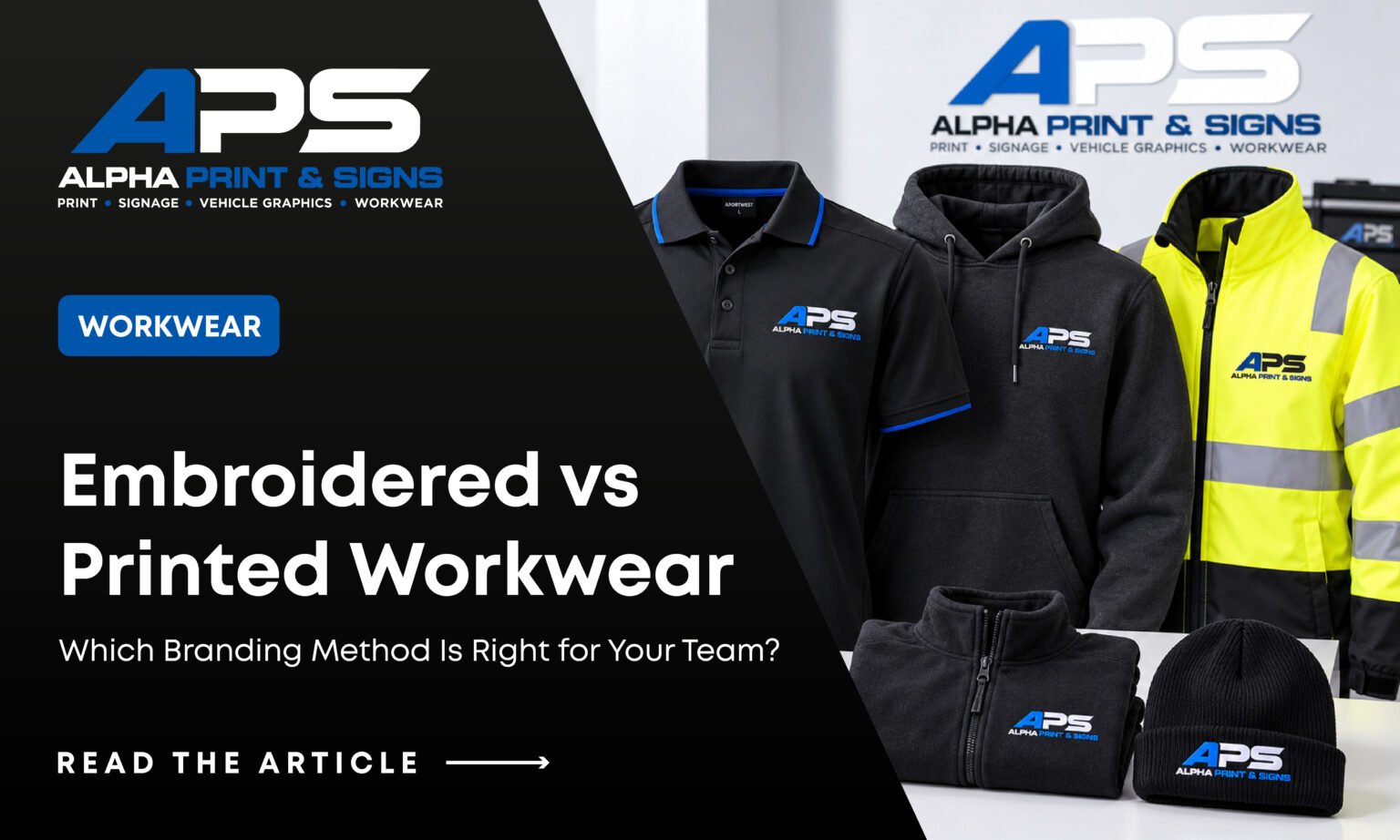
Embroidered vs Printed Workwear: Which Is Best for Your Business?
When choosing embroidered vs printed workwear, there isn’t one method that is automatically better for every business.
Embroidery gives logos a stitched, textured finish that works particularly well on polos, fleeces and jackets. Printing can reproduce larger, more colourful and more detailed designs, making it ideal for T-shirts, hoodies and prominent back graphics.
The right choice depends on your garment, logo, working environment, quantity and the appearance you want your team to have.
At Alpha Print & Signs, the aim isn’t simply to put a logo onto a garment. It’s to choose a branding method that suits how that garment will actually be worn.
[INTERNAL LINK → Branded Workwear | Anchor text: branded workwear]
Embroidered vs Printed Workwear: The Quick Answer
If you want the simple comparison:
| Embroidery | Printing |
|---|---|
| Premium stitched appearance | Smooth printed finish |
| Excellent for chest logos | Excellent for large graphics |
| Ideal for polos, fleeces and jackets | Ideal for T-shirts and hoodies |
| Best for simpler logos and lettering | Better for complex artwork and gradients |
| Highly suited to frequently worn workwear | Versatile across many garment types |
| Adds physical texture | Keeps designs flatter against the fabric |
For many businesses, the best solution is actually both.
You might embroider a company logo onto the left chest and print a larger telephone number, web address or graphic across the back.
What Is Embroidered Workwear?
Embroidered workwear uses thread to stitch your company logo or wording directly into the garment.
Before production, your logo is converted into an embroidery file that tells the machine where, how and in what sequence to place the stitches.
The result is a raised, textured finish.
Embroidery is particularly popular for:
- Polo shirts
- Fleeces
- Softshell jackets
- Gilets
- Work jackets
- Sweatshirts
- Caps
- Uniforms
A small embroidered logo on the left chest creates the classic professional workwear appearance used by trades, hospitality businesses, engineers, offices and service companies.
Why businesses choose embroidery
The biggest advantage is the finish.
Thread gives a logo physical depth and can make relatively simple branding look extremely professional.
Quality polyester embroidery threads are specifically used for demanding applications such as workwear because of their resistance to regular movement and washing. Madeira, for example, specifies polyester embroidery thread for frequently cleaned workwear and other demanding applications.
Recommended external resource: Madeira – embroidery threads for workwear
When Is Embroidery the Better Choice?
When comparing embroidered vs printed workwear, embroidery is particularly strong when you want a smaller logo that needs to look smart day after day.
Embroidery works well for professional uniforms
A stitched chest logo pairs naturally with a polo, fleece or jacket.
For customer-facing teams, it can create a polished and consistent appearance without making the clothing feel heavily promotional.
It suits thicker garments
Embroidery generally works very well on more substantial fabrics where the garment can support the stitching.
That includes many:
- Fleeces
- Polos
- Sweatshirts
- Work jackets
- Gilets
It’s excellent for simple logos
Company names, initials and relatively bold logos usually translate particularly well into thread.
The simpler the artwork, the cleaner the finished embroidery can appear.
[IMAGE PROMPT]
Visual Concept: Close-up photograph of a dark professional polo shirt with a crisp embroidered company logo on the left chest. Show the raised stitching and individual thread texture clearly, with a second branded fleece softly blurred in the background.
SEO Alt Text: Embroidered workwear with professional stitched company logo
When Can Printing Be Better?
Printed workwear applies the design to the surface of the garment rather than building it from stitches.
There are several garment-printing processes available, including transfer-based systems and direct-to-garment technologies. Modern digital garment systems can reproduce full-colour artwork and fine detail that would be difficult to recreate stitch-for-stitch with embroidery.
Printing is particularly useful for:
- T-shirts
- Hoodies
- Promotional clothing
- Large back graphics
- Full-colour logos
- Detailed artwork
- Telephone numbers and web addresses
- Larger quantities of staff clothing
Printed workwear handles detailed artwork well
Imagine a logo containing:
- Gradients
- Shadows
- Very fine lines
- Several colours
- Photographic elements
Trying to reproduce all of that with thread can require simplification.
Printing gives much more freedom for complex artwork.
Printing works well for large designs
A large embroidered graphic covering most of the back of a T-shirt would become heavy, stiff and unnecessarily complicated.
Printing is far more suitable in that situation.
This makes printed branding particularly useful for tradespeople who want:
small logo on the front + large company details on the back.
[INTERNAL LINK → Printed Workwear | Anchor text: printed workwear]
What About Cost?
The price of embroidered vs printed workwear depends on more than simply choosing one process.
For embroidery, cost can be influenced by:
- Size of the logo
- Stitch count
- Number of positions
- Quantity of garments
- Artwork setup or digitising
- Garment type
For printing, the important factors can include:
- Graphic size
- Number of printed positions
- Print method
- Quantity
- Garment material
- Artwork requirements
A small embroidered chest logo may make perfect sense, while printing could be more practical for a large design covering the back.
Rather than choosing purely by the cheapest unit price, choose the method that suits the design and intended use.
Which Looks More Professional?
This is subjective, but the two methods create noticeably different appearances.
Embroidery feels more traditional and uniform-like
It works particularly well for:
- Engineers
- Trades
- Hospitality teams
- Office staff
- Sales teams
- Customer-facing employees
Printing feels bolder and more graphic
It’s excellent for:
- Construction teams
- Delivery staff
- Events
- Promotional clothing
- Gyms
- Larger branding
- Marketing-led designs
Neither has to look cheap.
A poorly chosen embroidery can look cluttered, while a badly positioned print can dominate the garment.
Good branded workwear is about matching the technique to the design.
Your Logo May Decide for You
One of the easiest ways to choose embroidered vs printed workwear is simply to look at your logo.
Choose embroidery when your logo has:
- Clear shapes
- Strong lettering
- Limited fine detail
- Solid colours
- A relatively compact layout
Consider printing when your logo has:
- Colour gradients
- Photographic detail
- Extremely small elements
- Complex shading
- A very large design area
Don’t worry if your logo isn’t immediately suitable for embroidery.
Artwork can sometimes be simplified while maintaining the main brand identity.
[IMAGE PROMPT]
Visual Concept: Side-by-side close-up of the same fictional company logo reproduced twice: embroidered on a polo shirt and printed on a T-shirt. The logo should contain enough detail to clearly show the difference between stitched texture and smooth full-colour printing.
SEO Alt Text: Embroidered vs printed workwear showing the same business logo
Consider Where the Branding Goes
Placement matters just as much as the decoration method.
A typical branded workwear setup might use:
Left chest: Company logo
Right chest: Employee name
Back: Large logo, services or website
Sleeve: Smaller secondary branding
You don’t need to fill every available area.
For most businesses, a clear chest logo combined with strong back branding is enough.
A useful combination can be:
Embroidered logo on the front
Printed company details on the back
This gives the garment a professional appearance from the front while using the larger rear area as valuable advertising space.
A Note About PPE and Specialist Workwear
Ordinary branded workwear and certified protective clothing are not always the same thing.
If your garments form part of required personal protective equipment (PPE) — such as certain high-visibility, flame-resistant or specialist protective clothing — decoration needs additional consideration.
HSE guidance states that employers must ensure PPE is suitable for the risk, properly maintained and used in accordance with the manufacturer’s instructions.
That means you should not automatically assume a certified garment can be embroidered or printed anywhere without affecting its intended performance.
Check the specific garment and manufacturer guidance, particularly for specialist protective clothing.
Recommended external DoFollow resource: HSE – PPE selection and use guidance
Which Should Your Business Choose?
For most companies, this is a useful starting point.
Choose embroidery if you want a smart, long-term chest logo on polos, fleeces, jackets or uniform-style garments.
Choose printing if you need large branding, detailed artwork, colourful graphics or prominent information across T-shirts and hoodies.
Combine both if you want a premium embroidered logo on the front and larger advertising graphics on the back.
The decision doesn’t have to apply to your entire uniform either.
Your office polos could be embroidered while your site T-shirts use printed graphics.
The important thing is maintaining consistent branding across the team.
Order Branded Workwear From Alpha Print & Signs
Choosing between embroidered vs printed workwear becomes much easier once we can see your logo and know how the garments will be used.
At Alpha Print & Signs, we can help businesses create branded clothing for individual employees, complete teams and growing workforces.
Whether you need embroidery, printing or a combination of the two, start with:
- Your company logo
- The garments you need
- Approximate quantities
- Where you want the branding positioned
- Any staff names or individual details
We can then recommend the most suitable branding method for the garment and artwork.
[PRIMARY CTA BUTTON: SHOP BRANDED WORKWEAR]
[SECONDARY CTA BUTTON: GET A WORKWEAR QUOTE]
[INTERNAL LINK → Workwear category | Anchor text: personalised workwear]
[INTERNAL LINK → Embroidered Workwear | Anchor text: embroidered workwear]
Frequently Asked Questions
Is embroidery better than printing for workwear?
Not automatically. Embroidery is excellent for smaller logos on polos, fleeces and jackets, while printing is often better for large or highly detailed designs.
Does embroidered workwear last longer?
Quality embroidery is well suited to frequently worn and washed workwear, although lifespan ultimately depends on the garment, thread, washing conditions and how it is used.
Can I have embroidery and printing on the same garment?
Yes. A popular setup is an embroidered company logo on the front with larger printed branding across the back.
Is printing better for detailed logos?
Often, yes. Digital garment-printing methods can reproduce fine details, multiple colours and other artwork that may need simplification for embroidery.
What artwork do I need for branded workwear?
A high-quality logo is the best starting point. Vector artwork is particularly useful, but if you don’t have the correct file format, Alpha Print & Signs can review what you have and advise what is required.