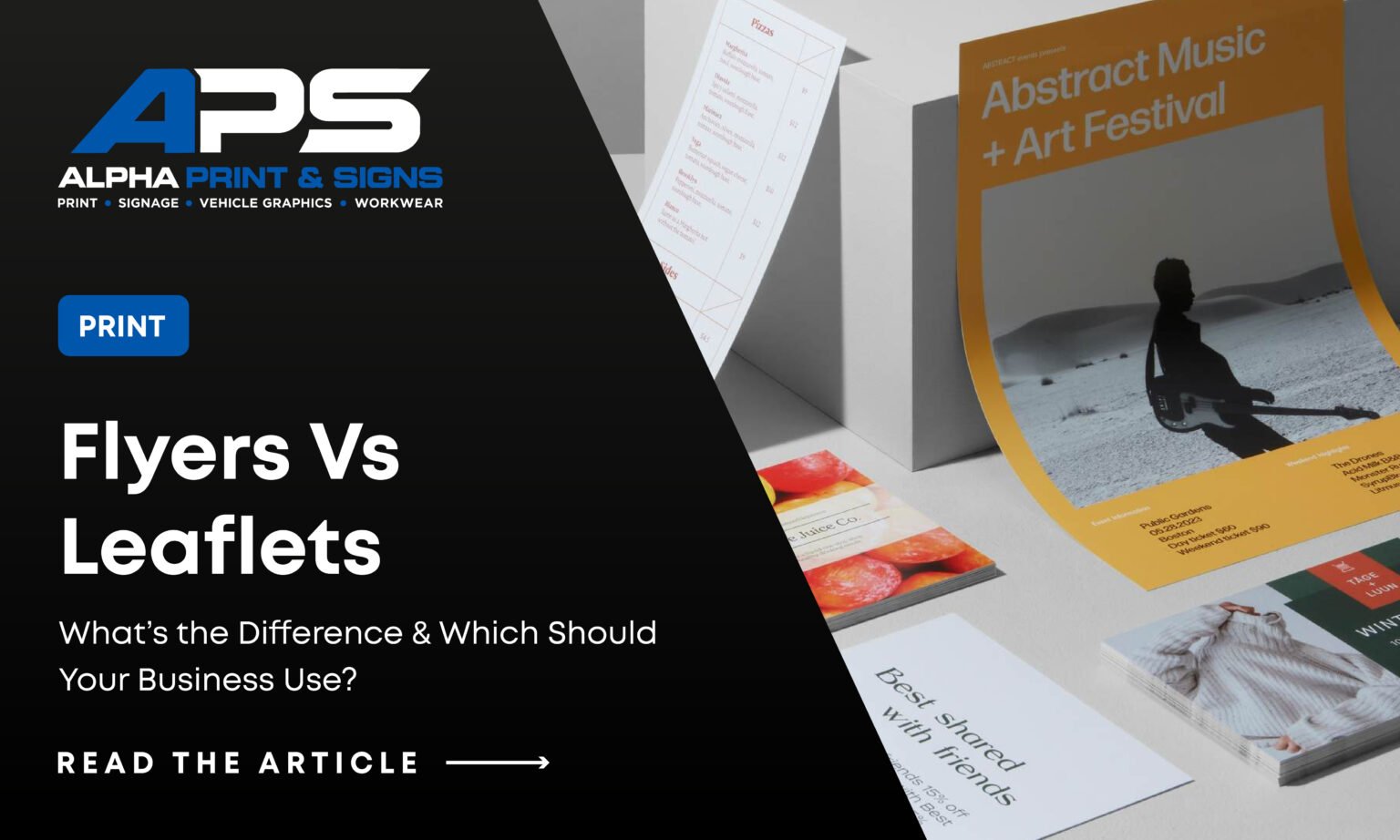
Flyers vs Leaflets: What’s the Difference and Which Should Your Business Use?
If you’re comparing flyers vs leaflets, you’re not alone. The terms are often used interchangeably, and in many cases two printers could use different names for almost exactly the same printed product.
The practical difference is usually much simpler: flyers tend to be flat, quick-impact promotional pieces, while leaflets often carry more information and may be folded into multiple panels.
But the name isn’t actually the most important decision.
What matters is choosing the right size, format, paper, finish and design for what you want your customer to do next.
In this guide, we’ll explain the difference between flyers vs leaflets, when each works best and how to choose a print specification that suits your business.
[INTERNAL LINK → Flyers & Leaflets product category | Anchor text: flyer and leaflet printing]
Table of Contents
- Flyers vs leaflets: what’s the actual difference?
- What is a flyer?
- What is a leaflet?
- Flyers vs leaflets comparison
- When should your business use flyers?
- When should you use leaflets?
- Which size should you choose?
- What paper should flyers and leaflets use?
- Single-sided or double-sided?
- What makes an effective flyer or leaflet?
- How many should your business print?
- FAQs
Flyers vs Leaflets: What’s the Actual Difference?
There isn’t a rigid universal rule separating flyers vs leaflets.
In everyday UK print terminology, both can describe a single sheet of printed paper used to advertise a business, product, service, event or offer.
However, there’s a useful practical distinction.
A flyer is usually:
- Flat and unfolded
- Designed around one main message
- Easy to read quickly
- Used for promotions, offers or events
- Distributed in larger quantities
- Often A6, A5 or A4
A leaflet is usually:
- Flat or folded
- More information-heavy
- Printed on one or both sides
- Used to explain services, menus or product ranges
- Designed to be kept and referred to
- Available in flat or multi-panel formats
So if your design says:
“20% OFF THIS WEEKEND – BOOK NOW”
…you probably need a flyer.
If it needs to explain:
Who you are, six services, three packages, prices, testimonials and contact information
…a leaflet or folded leaflet is probably more suitable.
That’s a much better way to think about flyers vs leaflets than getting caught up in terminology.
What Is a Flyer?
A flyer is normally a single, unfolded printed sheet designed to communicate something quickly.
Its job is usually to make somebody notice an offer, understand it within seconds and take action.
Business flyers are commonly used for:
- Special offers
- Sales
- New business openings
- Events
- Product launches
- Takeaway promotions
- Recruitment
- Property marketing
- Gym promotions
- Nightlife and entertainment
- Local service advertising
- Exhibition handouts
A strong flyer normally has one dominant message rather than trying to explain everything about the company.
Think:
NEW GYM OPENING – JOIN TODAY
rather than six paragraphs explaining the history of the business.
Why flyers work well
They are straightforward to produce, easy to hand out and flexible enough for everything from counter displays to local distribution campaigns.
Because they’re usually unfolded, the reader sees your message immediately.
[INTERNAL LINK → Flyer Printing | Anchor text: business flyer printing]
What Is a Leaflet?
A leaflet gives you more room to communicate.
It might still be a flat A5 or A4 sheet, but businesses often use the term leaflet for print containing more detailed information or for sheets that are folded into panels.
Common leaflet uses include:
- Service lists
- Takeaway menus
- Restaurant menus
- Price lists
- Product information
- Healthcare information
- Company introductions
- Treatment lists
- Tourist information
- Instructions
- Membership information
- Estate agency services
- Business-to-business marketing
A folded leaflet effectively turns one sheet of paper into several organised sections.
That makes it easier to guide the reader through a larger amount of information without creating one overcrowded page.
[IMAGE PROMPT]
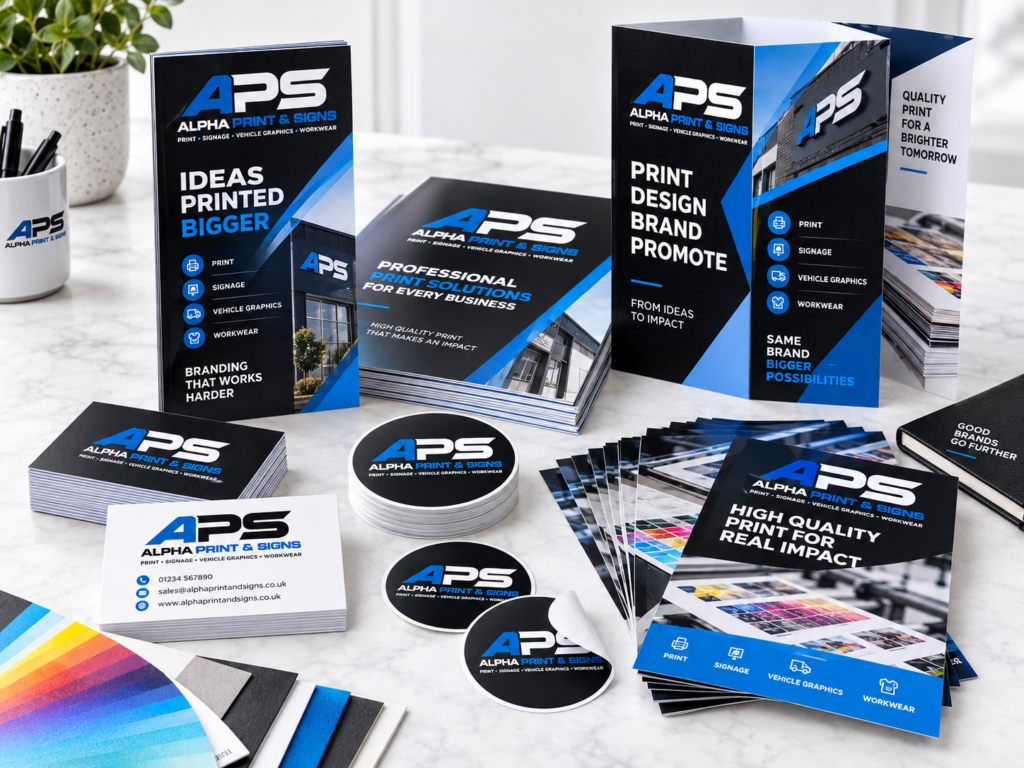
Visual Concept: Photograph or graphic showing a flat A5 promotional flyer beside an opened tri-fold DL leaflet. The flyer should have one bold offer and large imagery, while the leaflet has several clearly structured panels containing services, photographs and contact details. Use realistic UK business marketing designs.
SEO Alt Text: Flyers vs leaflets comparison showing flat flyer and folded leaflet
Flyers vs Leaflets: Quick Comparison
| Feature | Flyer | Leaflet |
|---|---|---|
| Typical format | Flat | Flat or folded |
| Main purpose | Fast promotion | More detailed information |
| Amount of content | Low to medium | Medium to high |
| Best for | Offers, events, announcements | Services, menus, guides |
| Common sizes | A6, A5, A4 | A5, A4, DL / folded formats |
| Distribution | Handouts, counters, door drops | Counters, door drops, direct marketing |
| Reading time | Usually quick | Usually longer |
| Main design priority | Immediate impact | Clear information hierarchy |
Neither option is automatically better.
The right choice depends on how much you need to say and what action you want the reader to take.
When Should Your Business Use Flyers?
When comparing flyers vs leaflets, choose a flyer when your campaign revolves around one strong message.
For example:
You’re promoting a special offer
A bold A5 flyer could say:
20% OFF YOUR FIRST ORDER
Then underneath:
Scan the QR code to claim your discount.
Nothing else needs to fight for attention.
You’re promoting an event
Flyers are ideal for communicating:
- Event name
- Date
- Venue
- Time
- Ticket price
- QR code
- Booking details
The reader should understand the key information almost instantly.
You’re opening a new business
A local door-drop campaign can introduce the company and provide an opening offer.
Restaurants, gyms, salons, tradespeople and retailers can all use flyers to target customers around their premises.
You need high-volume promotional print
Simple flat flyers are well suited to campaigns where hundreds or thousands of pieces need to be distributed.
Royal Mail, for example, offers a Door to Door service that allows businesses to distribute leaflets, flyers and brochures to selected postcode areas without needing individual household address data.
[EXTERNAL DOFOLLOW LINK → Royal Mail Door to Door | Anchor text: door-to-door leaflet distribution]
When Should Your Business Use Leaflets?
Leaflets become particularly useful when your customer needs more information before taking action.
Consider flyers vs leaflets from the reader’s perspective.
If seeing your offer is enough to make someone act, choose the simpler format.
If customers are likely to have questions before buying, give yourself more room.
Service businesses
A folded leaflet could have individual sections for:
- Plumbing
- Heating
- Bathrooms
- Boiler servicing
- Emergency call-outs
- Contact information
Trying to place all of that onto one side of an A5 flyer could result in a cramped design.
Restaurants and takeaways
A menu naturally requires categories.
Multiple panels make it much easier to organise starters, mains, drinks, meal deals and ordering information.
Beauty and healthcare businesses
Treatments, packages and prices often need more explanation.
A well-designed leaflet can present them clearly while keeping the final piece compact.
B2B companies
Leaflets are also useful for exhibitions and sales meetings where customers may take the material away and refer back to it later.
[INTERNAL LINK → Folded Leaflet Printing | Anchor text: folded leaflet printing]
Which Flyer or Leaflet Size Should You Choose?
Size can completely change how the finished print feels.
A6 – 105 × 148mm
A6 is compact and easy to hand out.
It works particularly well for:
- Discount vouchers
- Event promotions
- Appointment promotions
- Small handouts
- Simple offers
Space is limited, so the design needs to be concise.
A5 – 148 × 210mm
A5 is one of the most versatile choices for flyers and leaflets.
It’s large enough to accommodate a strong photograph, headline, supporting text and call to action without becoming difficult to distribute.
Good uses include:
- Business promotions
- Door drops
- Takeaway advertising
- Property marketing
- Events
- Local services
If you’re unsure where to start, A5 often provides a useful balance between available design space and practical distribution size.
A4 – 210 × 297mm
A4 gives you considerably more space.
It can work for:
- Detailed price lists
- Menus
- Product information
- Larger promotional posters handed out as flyers
- B2B information sheets
However, don’t choose A4 simply because you have lots of text.
Sometimes an A4 sheet folded down to DL will organise the same information more effectively.
DL – 99 × 210mm
DL is the familiar tall, narrow format commonly associated with folded promotional material.
An A4 sheet can also be folded into three panels to create a compact DL-sized finished leaflet.
This works particularly well for:
- Service guides
- Price lists
- Restaurant promotions
- Tourism
- Appointment information
- Business introductions
[IMAGE PROMPT]
Visual Concept: Clean size comparison infographic displaying A6, A5, A4 and DL print formats to scale. Include each dimension clearly and a small suggested business use underneath each format. Use Alpha Print & Signs blue, black and white visual styling.
SEO Alt Text: Flyer and leaflet sizes including A6 A5 A4 and DL printing
What Paper Should You Choose for Flyers and Leaflets?
The paper you choose affects both the feel of the product and how customers perceive it.
The exact stocks available will depend on the print product you’re ordering, but weight is normally expressed as gsm — grams per square metre.
Higher gsm generally means a heavier, more substantial sheet.
Lightweight paper
Lighter stocks can be suitable when you’re producing a large number of promotional pieces and keeping weight or unit cost down is important.
They’re commonly considered for:
- High-volume distribution
- Temporary promotions
- Information sheets
- Mass marketing campaigns
Mid-weight paper
A medium-weight stock gives flyers a more substantial feel while remaining practical for larger quantities.
It’s a good all-round option for many business promotions.
Heavy paper or card
Heavier stocks can make a flyer feel closer to a postcard.
Consider them when the piece needs to feel more premium or durable.
Examples include:
- Luxury promotions
- Invitations
- Premium property flyers
- Voucher cards
- High-end product launches
[INTERNAL LINK → Flyers product page | Anchor text: printed flyers]
Gloss, Silk or Uncoated?
Your finish changes the way both colours and text appear.
Gloss
Gloss can work well when the design relies heavily on:
- Photographs
- Bright colours
- Food imagery
- Product images
- High-impact graphics
Silk
Silk offers a smoother, less reflective appearance and is widely suited to general commercial marketing.
It can work particularly well where you need a balance between strong imagery and readable text.
Uncoated
Uncoated stock has a more natural paper feel.
It can complement brands wanting a more understated aesthetic and can also be useful where the customer may need to write on the printed piece.
Don’t select a finish in isolation.
Think about the brand, artwork and purpose of the campaign.
Flyers vs Leaflets: Which Is Cheaper?
There isn’t one answer because the final price depends on the specification.
Factors affecting flyer printing and leaflet printing costs include:
- Finished size
- Quantity
- Paper weight
- Paper type
- Single or double-sided printing
- Folding
- Finishing
- Turnaround
- Delivery
- Artwork requirements
A simple flat flyer will generally require fewer finishing operations than a folded leaflet.
But cost per unit can also change considerably according to quantity.
This is why it makes sense to compare the finished specification, rather than simply asking whether flyers or leaflets are cheaper.
Single-Sided or Double-Sided Printing?
A common mistake is leaving the reverse of a flyer blank without considering whether that space could help make the campaign more effective.
If you’re already putting a physical piece of print into someone’s hand, the reverse can be valuable marketing space.
You could use it for:
- Contact information
- Opening hours
- Directions
- A map
- Customer testimonials
- Another service
- Social media handles
- A QR code
- Terms of an offer
That doesn’t mean every flyer should be packed with information.
A deliberately minimal reverse can be more effective than filling every available centimetre simply because it’s there.
What Makes a Good Flyer or Leaflet?
Whether you choose flyers vs leaflets, strong design matters more than the terminology.
1. Lead with one clear message
The reader should immediately understand why they should keep reading.
Compare:
QUALITY SERVICES AT COMPETITIVE PRICES
with:
GET £50 OFF YOUR FIRST BOILER INSTALLATION
The second tells the reader something specific.
2. Give the reader a reason to act
Your marketing should answer:
Why should I do something now?
This could be:
- A discount
- Limited availability
- A launch
- A free consultation
- A free quote
- A new service
- A useful piece of information
3. Include a strong call to action
Tell people what you actually want them to do.
For example:
Book Online
Call for a Free Quote
Visit Our Showroom
Scan to Order
Use Code ALPHA10
Don’t make the customer work it out themselves.
4. Make contact information obvious
Include the information relevant to the campaign:
- Website
- Telephone
- Address
- Social media
- QR code
Not every piece requires every possible contact method.
Prioritise the route you actually want customers to use.
5. Don’t overcrowd the design
One of the biggest differences when deciding between flyers vs leaflets should be the amount of information.
If your flyer needs seven tiny sections to fit everything, it’s probably no longer the right format.
Move to a larger size or a folded leaflet.
More space doesn’t mean you need more content.
It gives the important content room to breathe.
[IMAGE PROMPT]
Visual Concept: Side-by-side “Good vs Poor Flyer Design” example. The poor example should be visibly overcrowded with several fonts, weak hierarchy and too much copy. The good example should use one strong headline, professional image, short supporting copy and prominent call-to-action button or QR code. Use fictional business details.
SEO Alt Text: Effective business flyer design compared with overcrowded leaflet design
Don’t Forget Print-Ready Artwork
Great design still needs to be prepared correctly for print.
Typical commercial artwork considerations include:
- Correct finished dimensions
- High-resolution imagery
- CMYK colour where required
- Suitable bleed
- Safe margins
- Embedded or outlined fonts
- Print-ready PDF artwork
A 3mm bleed is commonly requested for UK commercial print supplied with artwork running to the edge, although you should always use the specification supplied for the exact product you’re ordering.
Bleed means extending backgrounds and images beyond the final trim line.
That prevents unwanted white edges appearing if the cut varies fractionally during finishing.
How Many Flyers or Leaflets Should You Print?
Start with the campaign rather than selecting a round number at random.
For a door drop, determine how many properties you want to target.
For an exhibition, estimate visitor numbers and how many pieces your team can realistically distribute.
For a restaurant counter, think about how quickly the material is likely to be used before prices or promotions change.
Consider:
- Audience size
- Distribution method
- Length of campaign
- Number of locations
- Expected response
- How quickly information may become outdated
Printing more can reduce the unit cost, but unused flyers sitting in a box aren’t cheap marketing.
The right quantity is one you have a realistic plan to distribute.
Flyers vs Leaflets: Which Should Your Business Choose?
Here’s the simplest decision.
Choose a flyer if:
- You have one main message
- You want attention quickly
- You’re promoting an offer
- You’re advertising an event
- You’re distributing large quantities
- You want the recipient to act quickly
Choose a leaflet if:
- You need to explain several services
- You have a menu or price list
- Customers need more information
- You need several clear sections
- The customer may keep it for reference
- Folding would make the content easier to navigate
And if you’re still unsure about flyers vs leaflets, don’t choose based purely on what the product is called.
Choose the format that communicates your message most effectively.
Order Flyers and Leaflets From Alpha Print & Signs
Your printed marketing only has a few seconds to make an impression.
The right size, paper and design can turn a simple sheet of print into something that gets noticed, kept and acted upon.
At Alpha Print & Signs, we can help businesses produce professional flyers and leaflets for promotions, events, menus, services, product launches and everyday marketing.
Whether you already have print-ready artwork or you’re still deciding what format to use, start by choosing the product that best suits your campaign.
Ready to get your marketing into customers’ hands?
[CTA BUTTON: SHOP FLYERS]
[CTA BUTTON: SHOP LEAFLETS]
[SECONDARY CTA: NEED HELP CHOOSING? CONTACT US]
[INTERNAL LINK → Flyers product page | Anchor text: order flyers online]
[INTERNAL LINK → Leaflets product page | Anchor text: leaflet printing]
Frequently Asked Questions About Flyers vs Leaflets
Are flyers and leaflets the same thing?
Sometimes.
The terms flyers vs leaflets overlap significantly in everyday printing. A flyer generally means a flat promotional sheet, whereas leaflet can refer to either a flat information sheet or a folded document containing more detailed information.
What matters most is the specification you order: size, sides, paper and whether it requires folding.
Which is better, flyers or leaflets?
Neither is automatically better.
Flyers are usually better for short promotional messages, while leaflets work well when the customer needs more information.
Choose based on the campaign rather than the terminology.
What is the best size for a business flyer?
A5 is a versatile option for many businesses because it provides enough room for a strong headline, imagery, offer and call to action while remaining easy to distribute.
A6 can work particularly well for compact promotions, while A4 provides considerably more space.
What should I put on a promotional flyer?
A strong promotional flyer should normally include:
- A clear headline
- The main offer or message
- Relevant imagery
- Key supporting information
- Business branding
- Contact details
- A strong call to action
The reader should understand the purpose of the flyer quickly.
Should flyers be printed on both sides?
They can be.
Double-sided business flyers give you additional space for information, testimonials, maps, terms, contact details or secondary services.
However, the design should still remain easy to understand.
Are folded leaflets better for service businesses?
They can be particularly useful when a business needs to explain several services.
Folding creates separate panels, allowing each section to have its own space rather than squeezing everything onto one flat page.
Can flyers be used for door-to-door marketing?
Yes.
Flat flyers and printed leaflets are commonly used for door-drop marketing. Businesses can distribute them themselves, use distribution companies or consider services such as Royal Mail Door to Door for postcode-targeted campaigns.
FINAL IMAGE
[IMAGE PROMPT]
Visual Concept: Premium overhead photograph of several professionally printed Alpha Print & Signs marketing products arranged together: A5 flyers, A6 promotional cards and folded DL leaflets. Use realistic customer artwork, crisp paper edges and visible print texture. Keep the composition clean and commercial with Alpha branding subtly present.
SEO Alt Text: Professional flyer printing and leaflet printing by Alpha Print & Signs